The rituals of Umrah are simpler than most first-timers expect — four clear stages, none of them physically complicated — but the nerves are real. You’re about to do something you’ve likely pictured for years, in a crowd of thousands of people who all feel exactly the way you do. That mix of excitement and worry about “getting it wrong” is completely normal, and it fades within the first hour once you’re actually moving through the steps.
We’ve walked hundreds of Bangladeshi pilgrims through their first Umrah, and the questions are almost always the same. Here’s the full sequence, explained plainly, along with the practical details — like a permit you now need before you even reach the Haram — that a lot of guides skip.
The Four Pillars of Umrah, at a Glance
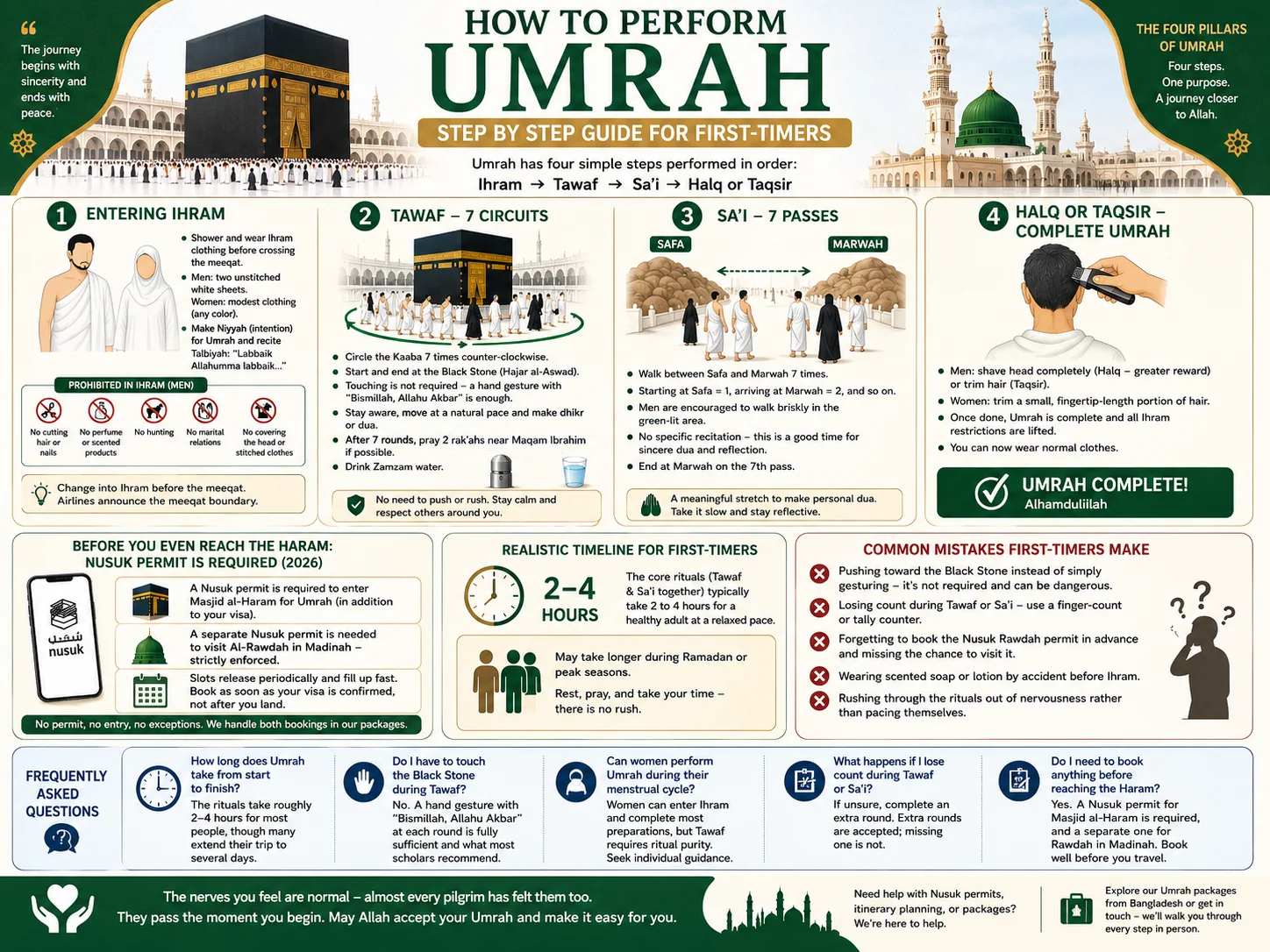
Umrah consists of four steps performed in order: entering the sacred state of Ihram, performing Tawaf (circling the Kaaba seven times), performing Sa’i (walking between Safa and Marwah seven times), and finishing with Halq or Taqsir (shaving or trimming the hair). That’s the entire ritual sequence — everything else is preparation and etiquette around it.
Step 1: Entering Ihram
Ihram is both a physical state (specific clothing) and a spiritual one (a set of intentions and restrictions you commit to). Before reaching the meeqat — the boundary point beyond which pilgrims must be in Ihram — you’ll shower, apply unscented care if needed, and change into your Ihram clothing. Men wear two unstitched white sheets; women wear simple, modest clothing in any color, with the face and hands left uncovered.
Most Bangladeshi pilgrims flying directly to Jeddah change into Ihram before departure or on the flight, since the meeqat boundary is crossed mid-air — airlines typically announce this over the intercom so you know when to make your intention.
Once dressed, you make Niyyah (intention) for Umrah, and begin reciting the Talbiyah: “Labbaik Allahumma labbaik…” — repeated often from this point until you begin Tawaf. While in Ihram, a few things are prohibited: cutting hair or nails, using perfume, hunting, marital relations, and — for men specifically — covering the head or wearing stitched clothing.
Step 2: Tawaf — Circling the Kaaba Seven Times
Once you enter Masjid al-Haram and see the Kaaba, you’ll begin Tawaf: seven counter-clockwise circuits around the Kaaba, starting and ending at the Black Stone corner (Hajar al-Aswad). You don’t need to touch or kiss it — a hand gesture toward it while saying “Bismillah, Allahu Akbar” at the start of each round is entirely sufficient, and honestly safer given how packed that corner gets.
Move at a natural pace, stay aware of the people around you, and don’t worry about reciting anything specific — general dhikr, Quran, or your own sincere dua all work. After completing seven rounds, pray two rak’ahs near Maqam Ibrahim if space allows (further back is fine when it’s crowded), then drink Zamzam water, available at dispensers throughout the mosque.
Step 3: Sa’i — Walking Between Safa and Marwah
Sa’i re-enacts Hajar’s search for water for her son Ismail: seven passes walking between the hills of Safa and Marwah, connected by a long covered gallery adjacent to the Haram. Starting at Safa counts as one; arriving at Marwah counts as two, and so on, ending at Marwah on the seventh pass. Men are encouraged to walk briskly through a marked green-lit section partway along the route; everyone else walks at a normal pace throughout.
Like Tawaf, there’s no fixed recitation — this is a good stretch to make sincere, personal dua, since it tends to be less crowded and more reflective than the Tawaf area.
Step 4: Halq or Taqsir — Completing Umrah
The final step is cutting hair: men can either shave their head completely (Halq, which carries greater reward) or trim it (Taqsir); women trim a small, fingertip-length portion of hair. Once this is done, Umrah is complete, and all Ihram restrictions are lifted — you can change into normal clothing.
Before You Even Reach the Haram: The Nusuk Permit You Need
Here’s something that’s changed recently and still trips people up: as of 2026, entry to Masjid al-Haram for Umrah is managed through a permit booked in the official Nusuk app, in addition to your visa — enforcement is generally strictest for independent travelers, though it’s worth having regardless of how you book. If you also plan to visit Al-Rawdah (the sacred area inside the Prophet’s Mosque in Madinah), that’s a separate, strictly enforced Nusuk permit with a QR code checked at the gate — no permit, no entry, no exceptions. Slots release periodically and fill up fast, so book this as soon as your visa is confirmed, not after you land. We handle both bookings as part of our packages, but if you’re arranging any part of your trip independently, don’t leave this until you arrive.
A Realistic Timeline for First-Timers
The core rituals — Tawaf and Sa’i together — typically take 2 to 4 hours for a healthy adult moving at a relaxed pace, longer during Ramadan or peak crowds. There’s no rule requiring you to rush; pausing to rest, pray, or simply take in the moment is completely normal, and most pilgrims find the whole experience more meaningful when they don’t treat it like a race.
Common Mistakes First-Timers Make
- Pushing toward the Black Stone instead of simply gesturing — it’s not required and can be genuinely dangerous in a crowd
- Losing count during Tawaf or Sa’i — using a simple finger-count or tally counter removes the stress entirely
- Forgetting to book the Nusuk Rawdah permit in advance and missing the chance to visit it
- Wearing scented soap or lotion by accident before Ihram, which is a common oversight for first-timers
- Rushing through the rituals out of nervousness rather than pacing themselves
Frequently Asked Questions
How long does Umrah take from start to finish? The rituals themselves take roughly 2–4 hours for most people, though many pilgrims extend their overall trip to several days to also pray extensively in the Haram and visit Madinah.
Do I have to touch the Black Stone during Tawaf? No — a hand gesture toward it while saying “Bismillah, Allahu Akbar” at the start of each round is fully sufficient and is what most scholars recommend given the crowding.
Can women perform Umrah during their menstrual cycle? Women can still enter Ihram and complete most preparations, but Tawaf specifically requires ritual purity, so this needs individual guidance — we’re always happy to talk this through directly with pilgrims before travel.
What happens if I lose count during Tawaf or Sa’i? If you’re genuinely unsure, it’s safer to complete an extra round than to fall short — most scholars agree an additional round doesn’t invalidate the ritual, while missing one does.
Do I need to book anything before reaching the Haram? Yes — as of 2026, a Nusuk permit is required to enter Masjid al-Haram, and a separate one is needed if you plan to visit the Rawdah in Madinah. Both should be booked well before you travel.
If this is your first Umrah, know that the nerves you’re feeling now are something almost every pilgrim before you has felt too — and they pass the moment you begin. For help with the Nusuk permits, itinerary planning, or choosing the right package for your trip, explore our current Umrah packages from Bangladesh or get in touch, and we’ll walk you through every step in person.