Your passport is new. The suitcase is not packed yet. And somewhere at the back of your mind a small question keeps repeating: what if I do something wrong?
That feeling is normal. Almost every person who has ever travelled to Makkah for the first time has carried it. They worried about the rituals, about getting separated from their group, about not speaking Arabic, about whether they would understand what to do and when. Then they went. And they came back wondering why they had spent so many nights worrying.
This guide is written for Bangladeshi Muslims preparing for their first Umrah, and for the sons and daughters arranging the trip for their parents. It is a roadmap, not a rulebook. It will show you the whole journey in order, tell you what to expect at each stage, and point you to the detailed articles you will need later. Read it once from beginning to end. By the time you finish, the sequence will feel far less frightening.
What Umrah Actually Is (and How It Differs from Hajj)
Umrah is the lesser pilgrimage. It is a set of acts of worship performed in Makkah, and unlike Hajj it can be performed at any time of the year. There is no fixed season, no standing at Arafah, no days of Mina. You travel, you enter the state of Ihram, you perform Tawaf and Sa’i, you complete the rituals, and you are done.
Performing the rituals themselves takes a few hours. The trip around them is what takes days.
Hajj, by contrast, happens once a year during a fixed window in Dhul Hijjah and includes rites that Umrah does not. It is one of the five pillars of Islam, obligatory once in a lifetime for those who are able. Umrah is described by many scholars as a strongly recommended act of worship rather than an obligation in the same sense. There are differences of opinion on this point, so if you want clarity for your own situation, ask a scholar you trust or the religious guide travelling with your group.
The scale is worth knowing before you arrive. Millions of people pass through Makkah every year. The Haram is not a quiet mosque on an ordinary afternoon. Understanding that early will help you prepare mentally.
Before You Book: Deciding Your Timing and Budget
Two decisions come before everything else: when you go, and how much you can comfortably spend. Both affect each other.
Ramadan is the most sought-after time, and for good reason. It is also the busiest and the most expensive. School holidays, Bangladeshi winter holidays and the Saudi winter season push demand up. The cooler months from roughly November to February are popular with first-timers because the walking is easier. Summer in Saudi Arabia is genuinely hot, and the crowds add to the strain. If you are taking elderly parents, timing matters more than almost anything else. Our guide to the best time to do Umrah from Bangladesh breaks the seasons down properly.
Most first Umrah trips run somewhere between one and two weeks, depending on how many days you spend in Makkah and whether you include Madinah. Some people go for a shorter, tighter trip. Others prefer a slower pace with more rest days built in.
Cost is driven mainly by four things: the season you travel in, how close your hotel is to the Haram, how many people share a room, and how long you stay. Flight routes and airline choice matter too. We have a full breakdown in our article on Umrah cost from Bangladesh, including what usually sits inside the package price and what does not.
One practical note before you go further. Set your budget first, then look at packages. Doing it the other way round is how people end up stretching themselves and losing the peace of mind they came for.
Choosing Your Package and Agency
Every agency will tell you it offers the best service. Very few will hand you a comparison sheet. So build your own.
Ask about hotel distance from the Haram in actual walking minutes, not hotel star ratings. Ask how many people share a room and what the bed configuration looks like. Ask whether intercity transport between Makkah and Madinah is included, whether meals are included, and what the group size will be. Ask whether a religious guide travels with the group and whether that guide speaks Bangla. For a first-timer, that last question matters enormously.
Licensing is not a formality. A licensed agency operates within Saudi regulations and has recourse if something goes wrong. Ask to see evidence of the agency’s approvals, and cross-check the official channels. The Saudi Ministry of Hajj and Umrah publishes information on approved operators and current regulations, and it is worth ten minutes of your time.
We have written two articles that cover this properly: one on how to choose an Umrah package and one on what’s included in an Umrah package. Read both before you sign anything.
If you are booking on behalf of your parents, sit with them while you compare. Their preferences about walking distance, room sharing and group pace will shape the decision more than the price will.
Getting Your Documents and Visa Ready
Your passport should have a good stretch of validity left. Saudi authorities generally expect at least six months from your date of travel, and an ordinary passport with a few blank pages. Check the expiry date today rather than next month.
Beyond the passport you will need photographs, your national ID, vaccination records and proof of your relationship to anyone travelling with you where applicable. Vaccination requirements, including the meningitis vaccine for pilgrims, are set by Saudi authorities and do change from time to time. The full list of what Bangladeshi pilgrims need is in our Umrah requirements from Bangladesh guide.
The good news is that most of the paperwork is handled for you. A licensed agency arranges your Umrah eVisa through the official Saudi system, and it is issued as an electronic record linked to your passport. You do not queue at an embassy yourself. What you must do is supply accurate documents on time and check every spelling against your passport. One mismatched letter can delay everything.
A note for women travelling: rules around mahram requirements have changed over recent years. Rather than relying on what someone did two years ago, confirm the current position with your agency and through official channels. Our Umrah visa guide for Bangladesh covers the process, and the Nusuk platform is the official Saudi portal you will use for permits, including Rawdah visits in Madinah.
What Happens on Travel Day
This part is not covered in detail elsewhere on our site, so we will slow down here. Knowing the shape of the day removes most of the anxiety.
You will fly from Hazrat Shahjalal International Airport in Dhaka. Most airlines and agencies advise arriving at least three hours before departure for an international flight, and during peak Umrah season the terminal is busy, so give yourself the full margin. Keep your passport, visa copy, ticket and vaccination certificate in one folder in your hand luggage, not in the checked bag.
Immigration and security are the usual steps. Expect queues. Expect to be asked where you are going. Answer simply.
Then the question every first-timer asks: when do I wear Ihram?
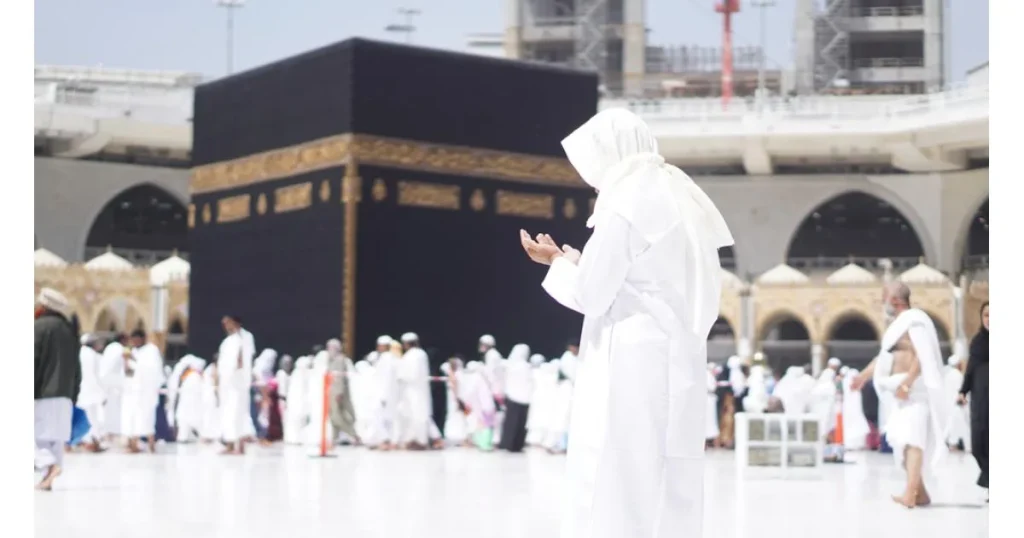
Men wear the two unstitched white sheets. Many Bangladeshi pilgrims put them on in Dhaka before boarding, or change at the airport, because it is easier than changing on the plane. Women wear their normal modest clothing; there is no special garment for women, though many choose plain, comfortable abayas.
Wearing the clothing is not the same as entering the state of Ihram. The state begins at the Miqat, the boundary point, when you make your intention and begin the Talbiyah. On a direct flight to Jeddah the Miqat is crossed in the air, and the crew will usually announce it. If you fly into Madinah first and travel to Makkah by road, your group will normally stop at the Miqat on the way, commonly at Dhul Hulaifah, also called Abyar Ali.
Follow your group’s religious guide on exactly when to make the intention. Do not guess, and do not rely on a video you watched once. Once in Ihram, certain ordinary things become restricted, and your guide will explain which.
You will land either at Jeddah, which is the gateway to Makkah, or at Madinah, depending on your itinerary. From the airport, your group transport takes over. Passport control in Saudi Arabia can take time during peak season, so keep your patience and stay with your group.
Your First Days in Makkah
You will reach your hotel tired and probably a little disoriented. Unpack later. Drop your bags, freshen up, and go to the Haram.
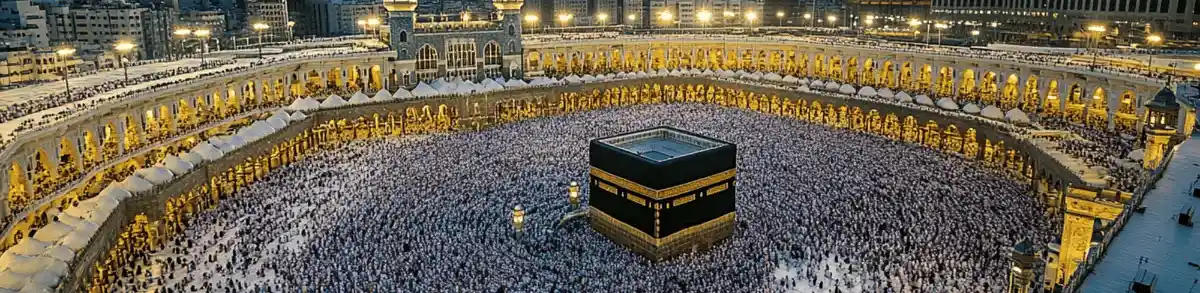
Nothing prepares you for the first sight of the Kaaba. People who have seen it a hundred times on screen still stop in the doorway and lose their words. Some cry. Some go completely quiet. Let whatever happens happen. This is the moment you have been working towards for months.
Within a day or so, you will perform your Umrah. Try to do it when you are rested rather than immediately after landing if your group allows it. The rituals are not physically complicated, but they involve walking, and the Haram is crowded at every hour.
The crowds are the thing first-timers underestimate. Tawaf during peak hours is dense, and the floor around the Kaaba fills quickly. Move with the flow rather than against it. If you feel overwhelmed, step to the outer areas of the mataf where there is more space, or sit and breathe for a few minutes. There is no shame in pacing yourself. Many experienced pilgrims deliberately perform Tawaf on upper floors where it is quieter.
Learn your bearings early. The Haram has numbered gates, and knowing your nearest gate number and your hotel name is the single most useful thing you can do in your first hour. Your hotel will have business cards at reception. Take two.
Give yourself rest. A first Umrah trip is spiritually intense and physically demanding. Sleeping enough is not laziness. It is how you stay well for the prayers you came for.
Understanding the Rituals in Simple Terms
Here is the whole sequence in plain language. Treat this as orientation, not instruction.
- Ihram is the state of consecration you enter at the Miqat, with the intention made and the Talbiyah recited. It comes with dress rules and a set of restrictions on everyday actions.
- Tawaf is seven circuits around the Kaaba, moving anticlockwise, beginning and ending at the corner where the Black Stone is situated.
- Sa’i is seven trips between the hills of Safa and Marwa, starting at Safa.
- Shaving or trimming completes the rites. Men shave the head or trim the hair. Women trim a small portion. After this, the restrictions of Ihram are lifted.
That is the shape of it. The details matter, and small differences in method exist between schools of thought. Rather than learning from a short summary, follow the full method in our guide on how to perform Umrah step by step, and check anything you are unsure about with your group’s religious guide. Asking questions is not a sign of weak faith. It is how everyone learns.
Travelling to Madinah
Most first Umrah itineraries include Madinah, and it is worth building in. The mood is different there. Makkah is intense and constantly in motion. Madinah is calmer, gentler, easier to walk in. Many pilgrims say the peace they felt in Madinah stayed with them longer than anything else.
The Haramain High Speed Railway connects Makkah and Madinah and is the quickest and most comfortable option. Seats sell out during peak season, so book early through your agency. Long-distance buses also run the route and cost less, with a longer journey. Both options are used regularly by Bangladeshi groups.
The centre of Madinah is Masjid an-Nabawi, the Prophet’s Mosque. Visiting the Rawdah, the area between the Prophet’s pulpit and his house, requires a permit arranged through the Nusuk app. Slots are limited and released on a schedule, with separate timings for men and women. Ask your agency to help you book, and confirm the current procedure before you travel, as the system is updated periodically.
Beyond the mosque, most groups arrange Ziyarat visits. The usual sites include Masjid Quba, the first mosque in Islam, Masjid al-Qiblatain, and the martyrs’ area at Mount Uhud. These are short visits, and they fit comfortably into two or three days.
Practical Tips Nobody Tells First-Timers
These come from pilgrims who learned them the hard way. None of them are complicated. All of them help.
- Wear something identifiable. In a crowd of thousands, you will lose sight of your group. A bright scarf, a specific coloured bag or a distinctive cap makes you findable.
- Agree a meeting point before you separate. Pick a specific gate number, not “near the Haram”. Write it down for anyone who does not have a phone.
- Memorise your hotel name and one landmark. If you get lost, you need to be able to say it clearly, in Arabic if possible, to a taxi driver or a volunteer.
- Keep a hotel card in your pocket. It has the name and address printed in Arabic. It has rescued a great many pilgrims.
- Carry a small bag for your shoes. You will remove them repeatedly. Losing them at a busy gate is far more common than you would think.
- Stay hydrated. Drink water regularly, even when you do not feel thirsty, and use the Zamzam stations.
- Do not rush. Everything can be done more than once. Nothing has to be done today.
- Pace elderly travellers properly. Wheelchairs are available, and there are services to help. Use them. Your parents will complete more prayers comfortably if they are not exhausted.
- Keep your phone charged. Carry a power bank and a spare charging cable. Save your group leader’s number under a name you can find quickly.
- Learn a few Arabic words. Simple greetings, please and thank you, and the words for hotel and water. People respond warmly when you try, and it makes asking for help far easier.
- Know your group’s daily plan. Ask each evening what tomorrow looks like. Uncertainty is what makes first-timers anxious.
Common Mistakes First-Timers Make
- Over-packing. You will wear the same few outfits again and again. Save your strength for the rituals, not for carrying bags. A sensible Umrah packing list will keep you light.
- Trying to do everything in the first two days. Arriving, performing Umrah, visiting every site and praying all night is not sustainable. Rest early and you will manage far more over the whole trip.
- Ignoring the heat. Dehydration and exhaustion catch people out. Use shade, drink water, and avoid the hottest hours where you can.
- Keeping all documents in one place. Split them. Leave copies in your hotel room, keep one set with your travel companion, and carry the originals on your person.
- Being shy about asking for help. There are volunteers and officials throughout both cities. Asking a question costs nothing and saves hours.
- Forgetting that rules change. Entry requirements, permit systems and transport options are updated from time to time. Verify current details with your agency before you travel rather than assuming last year’s advice still applies.
Frequently Asked Questions
How long does Umrah take to perform?
The rituals themselves usually take a few hours, depending on how busy the Haram is and how much you walk. Tawaf and Sa’i alone can take longer when the mataf is crowded. First-timers often spread the whole thing over a morning or an evening rather than pushing through in one stretch.
Do I need to know Arabic to perform Umrah?
No. You need to know a few specific phrases for the rituals, and everything else can be handled in simple English or through your group guide. Millions of pilgrims travel every year without speaking Arabic. Learning a handful of everyday words still helps a great deal when you are asking for directions.
Can I perform Umrah alone as a first-timer?
People do, but for a first visit it is worth joining a group, even a small one. A guide takes care of the sequence, the transport and the timing, so you can focus on worship. If you do travel independently, plan your logistics carefully in advance and confirm current entry requirements yourself.
What if I make a mistake during the rituals?
Most mistakes first-timers worry about are minor, and Allah is forgiving. If you realise you have missed a step or done something in the wrong order, do not panic. Speak to your group’s religious guide or a qualified scholar, who can tell you what, if anything, is needed in your specific case. Details of expiation differ between schools of thought, and this is not something to resolve from a blog post.
How many days should a first Umrah trip be?
Most first-timers travel for somewhere between one and two weeks. A common pattern is several days in Makkah and two to three in Madinah. If you are taking elderly parents or young children, lean towards the longer end. Fewer rushed days will always serve you better than a packed itinerary.
If you are still in the early stages of planning and want to see what a full trip looks like from start to finish, start with our Umrah packages from Bangladesh. Read the details slowly, write down your questions, and ask them before you commit to anything.
Your first Umrah will ask a lot of you. It will also give you far more than you expect. Go prepared, go rested, and let the journey unfold one step at a time.
Leave a Reply